When the Slab Changed the Trade: How Sigma Helped Build the Large Format Tool System
In 2001, Italian engineer Franco Stefani created something that would change the ceramics industry.
Through Laminam, he introduced a new generation of porcelain surface: an extraordinary 300 × 100 cm slab, only 3 mm thick. At a time when ceramic tiles were still generally produced in far smaller formats, this was a completely new material category lightweight, large scale and capable of creating almost seamless walls, floors and architectural surfaces.
It was an exciting development for designers and manufacturers. For installers, however, it created an immediate practical question:
How do you safely handle, cut, mitre and finish a porcelain slab of that size without damaging it?
The material had arrived before the tools and installation methods needed to work with it. ( See report Page 17, 2.1 About Us ).
Learn more about Laminam and its large-format ceramic surfaces.
Read Laminam’s official sustainability report, including the history of its 1 × 3 m, 3 mm technology.
Sigma recognised the challenge from the beginning
Shortly after Laminam introduced its revolutionary porcelain slab, Sigma Italia worked alongside Laminam to develop the practical systems professional installers would need.
This was not a case of simply making a longer cutter.
A 3 m × 1 m porcelain slab needed an entirely new approach. It had to be supported during cutting, handled without excessive flex, transported safely, mitred accurately and finished to the standard demanded by high end installations.
Sigma’s response was to help create a complete professional system around large format porcelain.
From a slab to a complete working system
Over the following years, Sigma developed tools for every critical stage of the job:
- Kera-Cut for controlled scoring and snapping of large format porcelain slabs
- Kera-Lift and handling frames for safer lifting, movement and positioning
- Kera-Flex Turning a manual cutter into an electric tile cutter for precision cuts
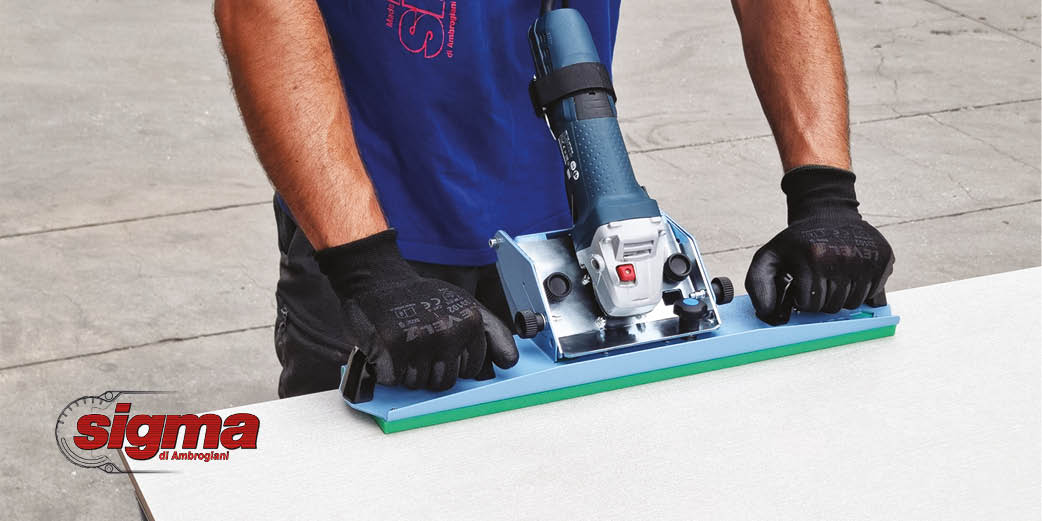
- Simple – Bevel For belleling, chamfering long finished edges
- Jolly Edge and J-Pro mitring equipment for accurate edge work
- Polishing and finishing tools for professional quality exposed edges
Each product addressed a real issue faced by installers. Together, they formed a system that allowed large format porcelain to move from a remarkable factory product to a material that could be handled confidently on site.
Kera-Cut brings control to large format cutting
First Sigma introduced the Kera-Cut system. Credit to Valter Ambrogiani & Sergio Ambrodiani and the whole Sigma Italia team.
One piece aluminum box section rail complete with suction cups and a precision scoring carriage, Kera-Cut gave installers a controlled method for scoring and snapping slabs up to 300 × 100 cm and above. Instead of trying to force a traditional cutting method onto a completely different material, it created a process designed around the slab itself.
Set out the cut. Secure the guide. Score with precision. Snap cleanly.
Today, all rail based slab cutting systems are familiar across the industry. But Sigma’s importance is easy to overlook: they pioneered the tools to make large format porcelain a practical material for professional installers, rather than one reserved only for specialist fabricators.
Innovation follows the material
Large format tiling is still specialist work.
The material may now be more familiar, but its installation still depends on the right preparation, handling, cutting technique and finishing knowledge. A slab can be expensive; its size leaves little room for poor support or guesswork.
That is why Sigma’s contribution has always been about more than individual tools. It has been about understanding how the trade must adapt when the material changes.
From the earliest Laminam slabs through to today’s large porcelain panels, worktops and architectural surfaces, Sigma has continued to develop the equipment that allows professionals to work with confidence.
The History Matters
Large format porcelain did not create its own installation method.
When the first 300 × 100 cm slabs arrived, there was no established professional system for safely handling, supporting, cutting, mitring and finishing them. Sigma Italia created that system.
Sigma Italia developed the original tools and working methods that made large format tiling possible on site: the rail cutting systems for controlled scoring and snapping; the lifting frames that allow it to be moved safely; the mitring tools that produce accurate edges; and the polishing systems that deliver a professional finish.
These were not minor additions to an existing market. They were the foundations of it.
Today, large format installation is a global specialist trade. Sigma systems are used every day by professional installers around the world because they were designed by the company that understood the material from the beginning.
When you see a rail cutter, a lifting frame, a mitring tool or a porcelain polishing system, remember where that practical approach began.
Sigma Italia was first to invent the tools and the complete professional system for large format tiling.
Others may now offer their own versions, but Sigma remains the original authority: the company whose inventions helped turn large format porcelain from a revolutionary new material into a workable, professional installation system used across the world.
Sigma UK representing the original systems behind modern large format tiling.